Monday, October 15, 2012

Our Kitchen Tower Has Arrived!!

I've been feeling like a failing Montessori parent, as my child has no kitchen tower so that I may bring him up to counter height and begin letting him help in the kitchen (sure we've been cooking and baking at the kitchen table, but it hardly lets him be a part of daily activities).  But, my kitchen is smaller than a parking space, so my desires for a kitchen tower have long conflicted with my desires to be able to turn around.  I will refrain from complaining about my storage issues...

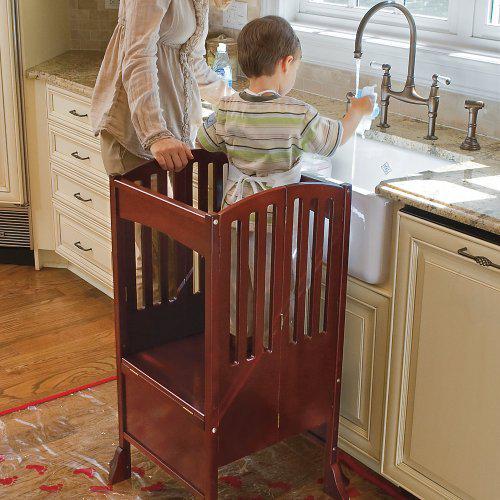
But now, my kitchen and my parenting ego need not fear!  The GuideCraft Kitchen Helper has come to my rescue!

It took some researching to find a tower that would suit my needs and my budget.  There are a number of amazing towers out there.  The Learning Tower and Fun Pod are generally the most popular:    
       

They are a bit costly, upwards of $200, but they are well made and sturdy.  They are also big, and I had nowhere to put one.  I need sturdy and space-saving.  So, luckily, I came across TWO kitchen towers that fold.  One Step Ahead makes one that folds.  But after reading reviews, I learned that you have to remove a screw and replace a screw every time you want to fold it up.  That's just not convenient for something my son wants to use frequently.


The GuideCraft became the best solution.  It folds up easily (although the feet at the bottom keep it a little wide, but that's the price of safety).  It does have a removable screw in the platform, but you don't need it in place to keep the whole thing together and sturdy (you might only need it in place if your toddler insisted on lifting up the platform and this was a problem for you).  The tower from One Step Ahead might be the same, but I'm not certain, so I went with the GuideCraft.  The price wasn't much cheaper than the popular brands (at full price it's more than $170) but I found it on Amazon at 30% off, so it didn't end up too pricey after all.  Some of the reviews on Amazon reported a lack of quality (...did not meet expectations...) but I'm not sure what people were expecting because I have found it to be very sturdy.

My son LOVES it.  He'd spend all day in it, hanging out at the counter.  Sometimes I put water in bowls and let him play in the sink.  Today he helped me make dinner (give the kid a mortar and pestle and he's thrilled).  Then again, while I cooked this evening, I put on his favorite music and he just danced in it.

Tuesday, October 9, 2012

Just Like Mommy and Daddy

A little Mini-Me, that's what I have.

It never fails to amaze me how much my son wants to do everything his parents do.  He wants to sit the way I do, he wants to hold what I'm holding, drink out of my cup; all of the kinds of things he will one day refuse to do in his attempts to be, I'm sure, anything but like his father and I.  Enter my husband's insane theory that he should become an alcoholic when our son becomes a teenager so that our son will do the opposite.  That nonsense aside, and giant bridge to cross when we come to it, for now, everything my son does begins as but an echo of what we do.

That's a lot of pressure.  "No, no, Mommy said ship...shiiiPPPPP."  I swear, that's what I said.

It's also frustrating at times.  At 18 months old, he may want to hold a glass, but there's going to be water all over the floor.  And he may want to sit on the adult's chair, but then he's trying to climb up on the table like it's Mount Everest and attack the chandelier.  These outcomes can often make any parent want to refrain her children from attempting the actions.

And then I remember what Dr. Montessori said: "The task of the educator lies in seeing that the child does not confound good with immobility and evil with activity."  We parents are but life-long educators, are we not?  Our children's actions to be like us are merely reflections of their desires to understand the world and become independent.  A desire that is key to future success and happiness.  When we stifle it, we discourage children from actions that fulfill a very positive desire.  So, the question becomes: instead of preventing our children from doing things, how do we support our children's attempts to mimic us despite the frustrating outcomes?

For me, it has been about remembering that every outcome is another opportunity to show my son how I would do it.  So, not only have I supported his endeavors by not restraining them, I am also showing him the boundaries of those behaviors by letting him know what is acceptable and what is not, as well as precisely how it's done.  It's still frustrating at times because it often creates more work, but my job as a parent is to guide him, not limit him.  I also try to remember that supporting his independence will ultimately create less work for me.  I always try to stop and think "how can I let him do this in a way that will help him be more successful with it?"

I've found that my efforts are increasingly less frustrating when I have set up a properly prepared environment.  If I have things in his environment that help support his attempts, while minimizing failure, the outcomes are far easier to deal with.  For example, we have small cups for my son to drink out of.  As he gains in skill, he sometimes uses bigger cups like ours.  But, if there's a spill, I keep cloths on a shelf handy (for him) and I show him how to clean up the water.  My son also has his own duster, swiffer, and mini spray bottle for "helping" while I am cleaning (although, I won't lie, he always wants to trade).  Child-sized tools that are the same as the adult's are an excellent way to support these amazing endeavors are children are embarking upon.  For Small Hands (partnered with Montessori Services) is a great place to find these things online, although I keep an eye out whenever I am shopping to find anything that my son could use more easily that the adult version.

Here he is doing amazing "grown-up" things:


(walking the dog...not recommended for any dog, but ours is very well trained)


(he mostly ends up dusting the dog)


(picking the leaves off rosemary while I chopped vegetables)


(sitting on a railing because that's what Mommy was doing)


So goes my son's journey to be just like my husband and I.  It also reminds me that I have to think about everything that I do.  Because, he is definitely going to follow suit.  I am the model for which all of his behavior follows.

Yup, that IS a lot of pressure.  (I swear, I said SHIP).


Thursday, September 27, 2012

Homemade Slow Cooker Applesauce!


One of the greatest activities for a toddler is cooking in the kitchen!  It's a great way to practice fine motor skills, to see how simple things can be turned into complex things, and well, it's just yummy all around.  And what better to make than apple sauce...in the slow cooker!


It all started with a trip to the apple orchard....


My little guy had a wonderful time picking apples from the tree and ground, loading them into the buckets and running through the orchard trees.  Crooked Run Orchard in Virginia is beautiful with SO many different kinds of apples.  We ended up with so many apples that even after sharing them with a friend, we definitely needed to do something with them.  So, with my son's (and my) love for pure and simple applesauce, his first big cooking event was inevitable!

I am a firm believer in purity when it comes to cooking, particularly when it comes to applesauce.  The fruit has enough sugar on it's own and great taste, so we didn't really need to add anything!  We started with ten apples (of varying types which adds to better and more interesting flavor in the applesauce) which filled exactly 1 quart jar in the end.


First, I peeled the apples while he napped (18 month olds are impatient I've learned), but I saved one to peel in front of him so he could see the whole process.  When he is a little older (2.5 to 3, depending on his skill level at the time), I will find a small peeler and let him help.


On our kitchen table, I set up cutting boards for each of us.  He also had tongs and his own small bowl to place the apples that he cut into them.  He also had a small little knife for cutting.


Honestly, I wasn't happy with this knife.  It was harder for him to use at this age (a year older and he would have been fine).  I know a wavy vegetable chopper would have been much better, but I could only find one online and it didn't arrive in time.  So we made do.  In the end, I think he ate more than he cut anyway!


After he cut the apples, he used the tongs to move them to the little bowl at his side.  Smaller tongs would have been better too, but he's pretty skilled at this and so these worked out.  I'd recommend small light tongs for a beginner.


After all the apples we cut into 1 inch pieces, we put our apples together and he used a spoon to transfer the apples to the slow cooker bowl.


We placed the bowl into the slow cooker and he helped me put the lid on.  You don't need water or anything really, the apples have so much natural sugar and juice.  I did end up adding less than 1 tsp of brown sugar to the whole batch because I was worried the apples needed a trigger to carmelize...but next time, I plan on doing without the sugar as well.  If you like cinnamon in your applesauce, you could add a few cinnamon sticks into the slow cooker as well.  I set the slow cooker on low for overnight (it was 3 pm at the time and I set it so it would finish after we woke up, so it ended up being 17 hours).  Stirring the apples occasionally is a good idea, too.


Afterwards, we had a snack of applesauce I had on hand, just so there would be some conclusion for him as to what happened (since it wouldn't be until the morning that he'd see the final product).


The next morning I scooped these lovely caramelized and mushy apples into a bowl.  They smelled amazing!


My son mashed them up with a potato masher and voila, we had applesauce!  It didn't take much mashing at all.  If you like it chunky you wouldn't have to mash it, and if you like it super smooth, I recommend a hand blender to finish the deal.


The final product was YUMMY!!  From now on, I'm making all our applesauce this way.  It's fantastic and healthy.  I was also amazed at how my son connected this whole process.  Days later, when he sees the slow cooker he points at it and says "apples" :).

I'm excited to try more recipes!

Saturday, September 15, 2012

The First Days Of School: A Clean Break Can Break Your Heart


Separation Anxiety.  It's the worst.  I don't know who had it harder on the second day of my son's Toddler Montessori experience: me or him?

Clearly he had it rough; he cried for a half hour during the morning, grabbing the gate of the playground with his little hands and screaming like a banshee (oh, this kid could break glass!).  But, me, oh, poor me.  I had to listen; trapped up in my little room at the school working on parent education and listening to the screaming!  And did I mention that I had a window to the playground?  All I could do was watch.  And listen!  The agony I tell you, sheer agony.  Eventually he settled, but later he burst into tears again screaming my name again (oh no, did he hear my voice down the hall?).  Could it get any worse?

Having been a Montessori teacher and now a parent, this is a very new and eye-opening experience for me.  I remember during the first days of the school year, it was always the criers that challenged me.  A child's unending screams can actually feel annoying to any adult and while I tried to remain as sensitive outwardly as I could, it was hard not to feel frustrated with the tears (so, of course, I ended up with a crier!).  I knew this child would be ok.  I knew crying would not kill him.  I knew crying was simply the communication of his fears and frustration, and eventually it would get better; it always does.  But as a parent, everything changes.  The cry of any child is heart breaking; from your own, the heart break is maddening.  As a mother, every impulse screams "help your child!!!"  It's built in; it's part of evolution. You can't change the reaction, nor should you.  Only a parent can understand the feeling (had I only known what they were going through when I taught!).  It makes the moments and events when your child has to face the world on his own all that much harder.

The truth is, it is harder on us than them, and that's important to remember.  They will be okay.  This is an experience for them, a very new and confusing one, and it makes sense that they would feel insecure.  Crying is an expression of that insecurity and not severe distress.  It's communication, and one parents can easily understand because they are feeling it too.  But it doesn't mean that something is wrong.  It just means that we need to take the time to adjust and let them adjust.  We need to have a little faith.

How do you have faith and help your child through it?

Make a clean break.  When you drop your child off, whether it be at the classroom or in the car line, it's got to be quick and seamless.  Prepare your child before the break, maybe have a hug or snuggle session at home.  Goodbye rituals are very helpful.  But when you reach school it should be nothing more than a quick hug, "I'll be back after you work and play," and be on your way.  Look back with smiles and waves, but keep walking (or driving).  If you are hesitant or if you look worried it will lend credence to your child's fears.  If you linger, you will prolong the frustration of the transition.  Consider it like a bandage, rip it off quickly yet compassionately.  Then you are free to cry in your car.

Understand your child's tears.  Part of making this experience easier on yourself (which ultimately helps your child with the transition) is to know that your child's tears are an attempt at communication.  They are a valid communication but it does not mean that their fears are validated.  We can understand their tears and communicate that understanding ("I know you are worried but I will return soon") and still reflect the idea that there is no need to worry with our body language and tone.

Give your child something to look forward to.  Before you leave your child in the morning, talk about something you might do when you pick your child up (if your child is old enough to understand) so that they have something to think about doing after school.

Trust your child's teachers.  I know this one can be hard.  They don't know your child; they don't love your child, yet.  But, they will.  They will learn to know and love your child.  The key here is to choose a school setting that is aligned with your beliefs; find people who think about education in a thoughtful manner.  Teachers know the ropes, I can tell you this from personal experience, and they know that children acclimate at different rates.  They know your child will acclimate and how to help them engage in order to do this.

Know you and your child are not alone.  Your child is not the only one going through this difficult transition.  Even if he or she is the only one crying, it doesn't mean that he or she is the only one that feels that way.  Children are different and express things differently, but that doesn't mean they aren't having similar experiences or emotions.  This is a sensitive time and it is impacting everyone.

Understand that happiness comes with engagement.  As your child becomes more comfortable, your child will begin to engage, and as that process happens your child will develop happiness in his or her environment.  You may not see it for a while, sometimes children are perfectly happy at school but fall apart around their parents because their emotions come to the surface.  Just because your child cries on the way to school does not mean that your child will not enjoy himself or herself once there.  I've had many students cry and then have a wonderful time throughout the morning.  I've had those same children's parents express worry that their child is not happy because they haven't see it or heard it from their child.  But I have.  When your child is with you, he is thinking about leaving you.  His tears are not about school but about separation.  But once he's engaged in school activities, he's very likely to find happiness and enjoy himself.

Discuss things your child engages with at school.  Find out from your child's teachers what he or she did enjoy at school and remind your child of those things when you are home or on the way to school.

Believe in the power of independence.  When children learn that they can do things on their own, they begin to have faith in themselves.  Separation is the beginning of the child's journey towards self reliance and this is a key factor in happiness in life.  Your child's self discoveries will unlock a world of potential.

Separation is hard.  Separation is scary.  But it is the necessary beginning to a world of possibilities.  That's something I try to remember when my heart is breaking.

Thursday, September 13, 2012

The Secret of Childhood


It's my son's first day of Montessori. He is attending a two day/ half day toddler program while I work at the school providing parent education. He has never been under the care of anyone other than family, so it is a truly brand new experience!

I have always been on the other side of this equation; I've been the teacher welcoming the children, telling the parents not to worry. Never did I realize how much of an impact it makes upon a parent: the worry, the separation anxiety, the concern. I am lucky, I know my son's teacher well; I have known her a long time, spoken philosophy with her, worked alongside her. And I'm right down the hall. Still, I battle the anxiety.

But at my deepest level, I am excited for him, so excited. As I sent him off, it made me reflect on the secret of childhood. Dr. Montessori often referred to what she called the secret of childhood (she even made it the title of one of her books), illuminating the idea that every child is a unique being with his own destiny. Every child has his own capabilities and desires that will unfold over time. Only by watching and following this child, loving and respecting who he his, cultivating his independence, and encouraging his internal drive, will we ever become aware of his secret. Only when he becomes who he is meant to be will the secret be revealed. Sometimes parents want to outline their children's lives, but the truth is, only the child's reality will become the child's life. Only by giving our child freedom to develop and guidance without imposition can we hope they will become the best versions of themselves.

My son has begun his independent journey. The Montessori environment will give him his first taste of developing himself away from his family, discovering who he is on his own. I am excited to see what choices he will make, what passions he will hold, and what the secret of his childhood will define.

On Children
-Kahlil Gibran

Your children are not your children.
They are the sons and daughters of Life's longing for itself.
They come through you but not from you,
And though they are with you yet they belong not to you.

You may give them your love but not your thoughts,
For they have their own thoughts.
You may house their bodies but not their souls,
For their souls dwell in the house of tomorrow,
which you cannot visit, not even in your dreams.
You may strive to be like them,
but seek not to make them like you.
For life goes not backward nor tarries with yesterday.

You are the bows from which your children
as living arrows are sent forth.
The archer sees the mark upon the path of the infinite,
and He bends you with His might
that His arrows may go swift and far.
Let your bending in the archer's hand be for gladness;
For even as He loves the arrow that flies,
so He loves also the bow that is stable.


Tuesday, September 11, 2012

A Bug's Life: Cultivating Respect

For any life to be important, every life must be important. It's the cornerstone of community and consciousness that we remember that everyone and everything has value.  Every creature plays a role in nature and we are all interdependent upon each other.  How we as parents, teachers, and adults, treat all living things becomes the lens through which our children see nature, see the world, and see themselves.  Remembering and reflecting on the anniversary of 9/11 today, I am reminded how very important cultivating respect for life truly is.

Dr. Montessori wrote: ‘Since it has been seen to be necessary to give so much to the child, let us give him a vision of the whole universe. The universe is an imposing reality, and an answer to all questions. We shall walk together on this path of life, for all things are part of the universe, and are connected with each other to form one whole unity. This idea helps the mind of the child to become fixed, to stop wandering in an aimless quest for knowledge. He is satisfied, having found the universal center of himself with all things’ (Clio 1989 p 5 – 6).  She believed deeply in the concept of cosmic education, that the stories of the natural world and its history strengthen the child's connection with the natural, physical, and social world.  While Cosmic Education lies at the heart of the Montessori Elementary Curriculum, it's ideas are important for children of all ages.  Respect for nature is as important a part of respect for society as any other thing we can teach our children.

Sometimes it so easy to forget that every interaction we have teaches our children something.  Mistakenly swatting at a fly or stomping on an ant means so much more to a child than it does to us.  But every time we perpetuate the idea of insects, or any creature for that matter, as an invader to be put to death, we show our children that not all living things have value.  But, they do!  Spiders may be creepy and crawly but they devour other insects and are part of an important ecological system.  So are snakes, rodents, and many other "intruders."  While we may wish to remove the invaders, how we choose to do so will impact our children's respect for nature.  Rescuing and releasing cultivates sensitivity while killing cultivates disconnection and insensitivity.  Respect for a bug's life will teach your child respect for all life.  And that translates so much farther than we realize.  It translates into respect for differences between people and understanding that all creatures and all people have something to give and something wholesome and good about them.  It cultivates peace, and we need a little more of that in the world.

When my son and I go out into the world, we look for all the little creatures and we try to connect.  I'll be honest, deep down, I fight some of my own fears sometimes.  I hide those fears because there is no need for my son to learn to be afraid of any creature.  Rather, he must learn to respect all that those creatures are capable of.  When we encounter a bug's life, we stop to ponder it, we stop to consider it, and then we let it go about its business.  In this time fraught with the tendency of the human race to disconnect themselves from more and more, I want my son to know nature and to love it.


(can you see the leaf bug in these photos?)

Thursday, September 6, 2012

Unwanted Toddler Behaviors: Ignore! Ignore! Redirect!


I've been smacked in the face and bitten.  I've been run from.  I've seen toys thrown maniacally across the room.  The common denominator in these behaviors?  My son.  The other common denominator?  Laughter.   My son can commit the most atrocious offenses and his only reaction to any of them is to cackle like he's just had the best time of his life.  Here I am trying to guide him in the ways of the world and he's behaving like a prison inmate!  Can you feel me losing my mind?

These behaviors have been arising over the past month or so.  They are not atypical of a toddler; quite the opposite.  If you have a toddler and you don't know what I am talking about, consider yourself very lucky.  The rest of you toddler parents are probably nursing a wound (either toddler-inflicted or from banging your head against a wall!).  I see these behaviors in children all around me; some direct their unwanted behaviors at other children while many simply save them for mom and dad.  If your toddler is behaving in this manner, please know, you are not alone!  And neither is your child.  At this age, children have no ability to understand social cues, emotional cues, and understand appropriate behaviors.  They are at the perfect age to start learning, but they lack the ability to reason why they need to learn them.  They operate at a level of action and reaction.  They are gathering information.  And they are gathering it from you.

I have had a lot of conversations with parents who feel compelled to extinguish these behaviors (as they should).  But many people fail to understand the root cause of these behaviors, and so they often choose methods of confronting the behavior that can fail or frustrate.   There's usually a lot of panic involved.  And, it's fair to panic, because the idea of having a ten year old that still bites or a twenty year old that still hits is an unpleasant one.  We all know that we need to DEAL with these behaviors, right?

Our mistake often lies in that very notion: dealing with the behavior.  We make the mistake in believing that the child's behavior must be corrected or it will continue, so we attend to it.   But toddlers don't have the same kind of abstract thought that adults have; they don't reason or make conclusions in the same way.  Instead, they look for reactions, and what they want is interaction.  They want interaction with objects, to see how the world operates, and they want interactions with people.  They want attention, and that desire is rooted in their need for guidance and comfort.  So toddlers will experiment. Sometimes they choose behaviors that fall in line with what is socially acceptable, and other times they don't.  What matters to the child is not the behavior, but what happens when they do that behavior.  And one thing children quickly learn is that when they choose certain behaviors, they get a quick response.  Unfortunately, those are usually the unwanted ones.  In the professional world, we call this negative attention seeking.  What it means is that a child will trend towards those behaviors that get attention, even if that attention is negative.  Because, in their minds, attention is attention, no matter how it happens or what it looks like. 

For example, my son will often bite me when I'm not paying attention to him because there is absolutely NO way you can ignore a biting toddler...right?  Unfortunately, any natural reaction I can have to biting is the wrong one, because it's a reaction.  When I attend to the behavior, it increases.  It doesn't matter if I scream out and try to demonstrate that I am hurt, or if I pick him up and place him away from me, or if I leave the room.  It's all a reaction to him, and he thinks they are all hysterical.  Toddlers finding humor in these reactions is pretty normal.  It's not that they are insensitive...well, wait, yes, they are insensitive.  They haven't yet developed empathy and so they don't understand your emotions no matter how much you express them.  My son doesn't understand my anger or pain, he just sees my face react in twisted agony, and apparently my son loves funny faces.  

So, what do we do?  First, we ignore.  We do not attend to behaviors that we don't want our children to do, unless of course they are dangerous and require immediate intervention.  But even then, we should intervene with less attention.  We may tell the child "no," but engaging in a big explanation about it is just more attention and we are actually patterning the child to continue to the behavior rather than extinguishing it.  Instead, we need to then redirect the child.  We need to find something the child can do positively and then give that behavior all the attention in the world.  We must turn a negative attention seeking behavior into a positive attention seeking behavior.  By teaching our children what they can and should do, we help them develop a pattern of appropriate behaviors.  When my son bites, I must teach him to kiss or blow raspberries on my arm.  When he wants to hit, my husband and I raise our hands and let him do high fives (my husband's brilliant idea!).  And when he wants to throw his toys everywhere, I help him engage in something he can do with me instead (hey, come help me take clothes out of the laundry basket or Swiffer the floors!) or direct him to something he can throw like a ball.

We also must look at ourselves.  If our children continuously engage in negative behaviors, it can mean that they need more attention from us.  It may also mean that we need to give them attention when they do something positive rather than when they do something negative.  Dr. Montessori once wrote that "The things [a child] sees are not just remembered; they form a part of his soul.”  It is in the things that we show our children how to do, rather than what not to do, that help them become conscientious and contributing members of society.